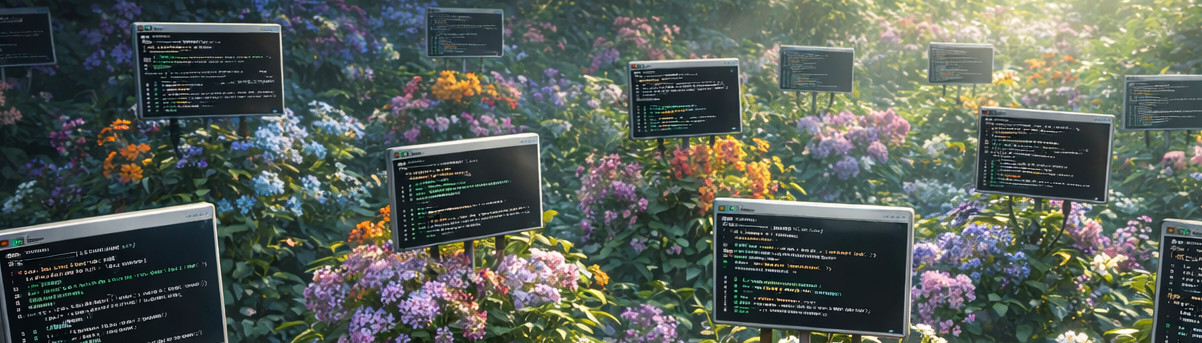
We Are Entering The Age of Software Abundance

We are living through the arrival of large language models as active participants in software development.
They are not merely a spicy autocomplete, not just syntax helpers anymore. They are more than marginal productivity boosters.
These frontier model generative AI systems can read entire repositories, reason across files, draft architectural changes, refactor code, generate documentation, wire integrations, propose migrations, and execute structured plans in collaboration with a human operator.
Coding agents are no longer curiosities. Agent frameworks are no longer toys. Toolchains are emerging that allow these systems to persist state, call tools, orchestrate multi-step tasks, and interact with infrastructure directly. The frontier models that power them are steadily improving. Hallucinations have not disappeared, but they have receded from catastrophic novelty to manageable risk in many real-world coding contexts.
What this looks like in practice
The result is not theoretical.
It is that a single person can now supervise work that would previously have required a small team.
I know this because I am doing it.
Right now, on my desktop PC, I have three terminals open.
In each of them, Claude Code is running against a different repository. In another pane, an OpenClaw agent is orchestrating multi-step tasks across a collection of Docker Compose projects that span several VPS instances distributed globally. These machines host the open source tools that make up my intellectual and organizational life. My data. My notes. My media. My experiments.
I am not merely watching code automatically complete, nor am I inactive or disengaged from the process.
I am supervising systems that are writing, refactoring, reorganizing, documenting, securing, and deploying themselves in conversation with me.
I can move between three disparate projects in the same hour. One model is wiring up monitoring and structured logging across services. Another is rationalizing environment variables and secrets management. A third is drafting hardened deployment scripts with version control hooks and audit trails. Meanwhile OpenClaw is stitching tasks together, managing state across interactions, pushing changes through structured steps that would previously have required a block of uninterrupted focus that I rarely possess.
The limiting factor is not the models.
It is my own context window.
If I lose track of which terminal is doing what, progress slows. If I remain present, actively listening, probing, redirecting, clarifying, the system accelerates.
By continuously engaging in structured feedback loops with these models, I am building out infrastructure that I simply would not have had the cognitive bandwidth to construct alone. I have wanted for years to deploy tools like Immich and Headscale and Audiobookshelf properly, not as weekend experiments but as hardened services with monitoring, test environments, clean repository structures, documented configuration, sensible separation between development and production, and predictable update paths. I never had the sustained attention to do all of that well.
Now I can.
Not because the work is less complex, but because the cost of initiating and iterating on that work has collapsed.
The cost of experimentation collapses
There is a strange inversion in this. At times I feel like I am merely facilitating conversations between agents, forwarding instructions, clarifying intent, nudging processes along. There is a risk of becoming the subagent in the loop, the thin human layer that authorizes and redirects. And yet this is not wage labor performed for someone else’s platform. I am saturating my own bandwidth in service of systems that enhance, secure, and extend my own personal goals. And it feels cathartic, liberating, and empowering.
The steady improvement of frontier models, the reduction of hallucinations to manageable levels rather than catastrophic ones, the integration of coding agents into familiar development environments, and the emergence of agent frameworks like OpenClaw have combined to produce a threshold event. We are collaborating with systems that can maintain context, reason across repositories, and execute structured plans.
The consequence is not simply faster coding; it is the radical lowering of the cost of experimentation.
For decades, the MVP has been central to agile development precisely because building something minimal still required meaningful investment. A sprint represented real trade-offs. Prototyping meant allocating scarce engineering time. The economics of development imposed discipline through friction.
That friction is evaporating.
When creation no longer requires hesitation
If a working implementation can be drafted while the idea is still being discussed, then discussion and construction begin to merge. If three possible approaches can be generated and explored before the end of a planning session, then design becomes something you observe rather than something you speculate about. If a small, purpose-built script can be written, tested, and discarded in the same afternoon, then inefficiencies that once lingered because they were not worth the effort start to disappear.
You begin to see a different species of software emerging. Not flagship products or monolithic systems, but small, sharply defined artifacts that exist to answer a question, to illuminate a dataset, to connect two services, to relieve a single bottleneck. Many of them will never become permanent. Some will evolve into durable components. The point is not their longevity. The point is that their creation no longer requires hesitation.
And when creation no longer requires hesitation, proliferation follows.
Ephemeral dashboards, transient automation layers, narrow internal tools that live for a week and disappear, all of these become economically sensible. In a previous era they would have remained ideas because the overhead of creating them exceeded their immediate benefit. Now the overhead is negligible.
This is where a historical analogy becomes useful; let us compare it to the Industrial Revolution.
Before mechanized looms, cloth was costly and clothing variety was limited. Most households owned very little because each garment embodied significant labor. When cloth became cheap, closets filled. The visible consequence was not simply more efficient mills, but the normalization of abundance. People owned more. They replaced more. They expressed more. Entire patterns of consumption and identity shifted because production ceased to be the primary constraint.
We are entering a similar moment in software. Digital closets are beginning to fill.
Company’s internal software repositories are multiplying. Automation layers are expanding. Micro-tools are accumulating. The ubiquity of software inside organizations is increasing, not through grand transformation projects but through steady accretion. When experimentation is cheap, experimentation becomes habitual and regularized. When iteration is inexpensive, iteration becomes constant.
Abundance demands more discipline, not less
This has profound implications for how teams operate, including our own at Opreto.
Agile ceremonies that once revolved around rationing effort now orbit around directing abundance. Planning becomes less about rationing effort and more about directing attention. Standups begin to include stories of what was tried and observed rather than only what was completed. Reviews become moments of selection from multiple viable artifacts rather than unveilings of a single carefully guarded increment. The MVP stops feeling like a checkpoint and starts feeling like a reflex.
None of this removes the need for discipline. If anything, it makes discipline more deliberate. Generative AI models cannot take responsibility, or have any kind of accountability. We still need humans in the loop. This burgeoning fountain of software actually intensifies the need for rigorous and holistic discipline.
When closets fill, you must decide what to keep.
When repositories fill, you must decide what to harden, what to archive, what to integrate into long term architecture. Security does not become optional because generation is cheap. Compliance does not solve itself or become automatic. Data residency does not lose importance. The risk surface balloons alongside the increased density and proliferation these models deliver.
Owning your stack becomes practical
That density and ubiquity is changing expectations in the software development industry.
If experimentation is inexpensive, teams will experiment more. If customization is easy, organizations will expect customization as a baseline rather than a luxury. If integration can be generated on demand, then siloed systems begin to feel less inevitable.
The difference is that the option set expands.
When bespoke systems were prohibitively expensive, dependency on centralized platforms was often the only rational choice. Workflows were shaped to fit monolithic tools because building alternatives was unrealistic. Now that small, tailored systems can be generated and refined with far less friction, organizations regain the practical ability to shape their own stack. They can decide where data resides. They can own their deployment pipelines. They can assemble modular components rather than inherit bundled constraints.
Sovereignty in this context is not rhetorical. It is operational. It is the capacity to determine how your digital environment is structured and how it evolves.
Abundance makes autonomy practical. Discipline makes it sustainable.
The role of the builder changes
What I am doing at home, juggling terminals and agents across distributed machines, feels at times like an eccentric personal experiment. In reality, it is a small-scale rehearsal. The motions that feel novel today will become ordinary. The idea that one person can oversee multiple intelligent agents building, refactoring, documenting, and deploying in parallel will cease to be remarkable.
We are in the early stage of software ubiquity, in the moment where the bloom has begun but its full shape is not yet clear.
The cost of experimentation has fallen so dramatically that it can no longer be treated as a rounding error in our thinking. When the minimum viable product costs almost nothing to attempt, everything downstream of that fact begins to reorganize.
The question is not whether more software will exist. It will.
What does this mean for us at Opreto?
It would be easy to frame ourselves as defenders against chaos, or to market ourselves as specialists in AI enablement, or to reduce this moment to a new capability we have added to a services menu. That feels too small for what is actually unfolding.
The economics of building have changed. And when the economics of building change, the role of the builder changes with them.
We are not interested in competing with models at the level of keystrokes. That layer is already commoditizing. The more meaningful layer now is architectural and cultural. It is about how organizations absorb this new abundance without surrendering coherence. It is about helping teams move faster without dissolving into sprawl. It is about embedding governance at the point of generation rather than bolting it on after the fact.
If experimentation is nearly free, then discernment becomes the scarce resource. If prototypes can be produced reflexively, then knowing which ones deserve to harden into infrastructure becomes the real leverage. If bespoke systems are suddenly affordable, then shaping them into a sovereign, secure, evolvable stack becomes strategic rather than optional.
This is where we see our work.
We have always spoken about Optimal Velocity, and in many ways this moment sharpens what that phrase truly means. Velocity is not raw speed. It is speed with direction. It is movement that compounds rather than scatters. It is acceleration that strengthens the system instead of destabilizing it.
In an era where software can bloom uncontrollably, optimal velocity requires stewardship. It requires architectural clarity. It requires intentional constraints that allow abundance to accumulate into something durable.
We see Opreto as a steward of acceleration. Not a brake, and not an amplifier without judgment, but a disciplined partner in harnessing what is now possible. We are already working this way internally, supervising agents, restructuring workflows, revisiting how agile ceremonies function when the MVP is a reflex rather than a milestone. We are learning what it means to design systems in which AI is native rather than incidental.
Our vision is not to build more software for its own sake. It is to help organizations build the right software, in the right way, with ownership over their data, their infrastructure, and their risk posture. To help them take advantage of ubiquity without being overwhelmed by it.
The bloom is underway. The repositories will fill. The tools will multiply. Expectations will rise.
Optimal Velocity in this world means embracing that abundance while ensuring that what grows is intentional, secure, and sovereign.
That is the future we are building toward.